Flat Belly After Childbirth
The essential knowledge every woman needs to avoid harming herself in the quest for a flat stomach after childbirth, and how to achieve a toned belly while caring for your women’s health.
This Mini-Course Is for You, Even If…
You’ve had multiple pregnancies.
You have diastasis recti.
You don’t believe your stomach can ever look like it used to, or even better.
Start Here
What’s Inside
Everyday Habits That Make Your Belly Stick Out and Your Back Hurt
Here are some examples of how to protect your back in daily life.
Lifting Your Baby Correctly
Squat down, grab your baby, engage your core and pelvic floor muscles, and lift with a straight back, using your arms for strength. Hold your baby close to your chest immediately after lifting. Then, stand up using your leg muscles, as demonstrated in the video.
Placing Your Baby in the Crib Correctly
Before placing your baby in the crib, step one foot back (bend the supporting knee), keep your back straight, engage your core and pelvic floor muscles, and gently place your baby using the strength of your arms. To maintain balance, lean slightly toward the crib. Alternate which leg you step back with to avoid strain. (I don’t have a crib anymore, so I’m demonstrating with a chair instead.)
Breastfeeding Correctly
While breastfeeding, ensure your neck and back aren’t under tension. Use a pillow under your back and neck if necessary, elevate your feet, and place your baby on a pillow (a nursing pillow works best). Both you and your baby should be comfortable!
Using Your Phone Correctly
Hold your phone at eye level to avoid straining your neck and developing a hump. Wherever you’re sitting, aim to keep your back straight, elongate your neck, and look forward. Arrange your workspace to maintain proper body alignment.
Holding Your Baby Correctly
When holding your baby, avoid tilting your pelvis or back for prolonged periods. Keep your body vertical and imagine a string pulling the top of your head upward.
Carrying Groceries Correctly
Distribute the weight of heavy bags evenly between both hands to prevent chronic shoulder imbalances. The same rule applies to carrying your baby: don’t rely on a “favorite arm.” Switch arms regularly.
By adopting these habits, you won’t have to fix slouched shoulders, poor posture, a neck hump, or back pain later. Unfortunately, many people live with these issues their entire lives!
Common Mistakes Moms Make When Trying to Get Rid of a Protruding Belly
It might seem straightforward: just eat less, run, do crunches, practice stomach vacuum exercises, and the belly will disappear! Many moms think this way because these methods are widely recommended. However, this approach has significant flaws.
Why Does This Strategy Not Work and May Even Be Harmful?
1. “Eating Less”
Suddenly reducing food intake can trigger the body’s “starvation mode,” slowing metabolism and promoting fat storage. Strict dieting often leads to stress and eventual overeating. It’s more effective to start by changing eating habits, which will naturally adjust the quantity and quality of food consumed, all without stressing the body.
2. “Running”
Running is excellent for a healthy individual. However, if pelvic floor muscles haven’t recovered postpartum, high-impact activities like running can lead to pelvic organ prolapse. Therefore, it’s crucial to first strengthen the pelvic floor muscles before incorporating running into your routine.
3. “Doing Crunches”
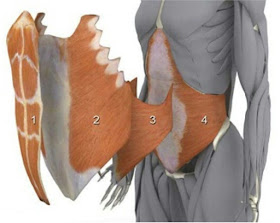
Traditional crunches primarily target the rectus abdominis (1), the muscle responsible for “six-pack” abs. This superficial muscle doesn’t significantly affect abdominal volume. To reduce belly protrusion, it’s essential to engage the deep abdominal muscles, such as the transverse (4) and oblique muscles (2, 3). Relying solely on traditional crunches may not flatten the belly and can even exacerbate diastasis recti.
4. “Performing Stomach Vacuum Exercises”
While the stomach vacuum is a great internal organ massage, it doesn’t reduce belly volume, strengthen muscles, or eliminate fat. Importantly, overdoing this technique or performing it incorrectly can worsen diastasis recti. If the diastasis is more than 2 cm wide, vacuum exercises are not recommended.
How to Check if You Have Diastasis Recti
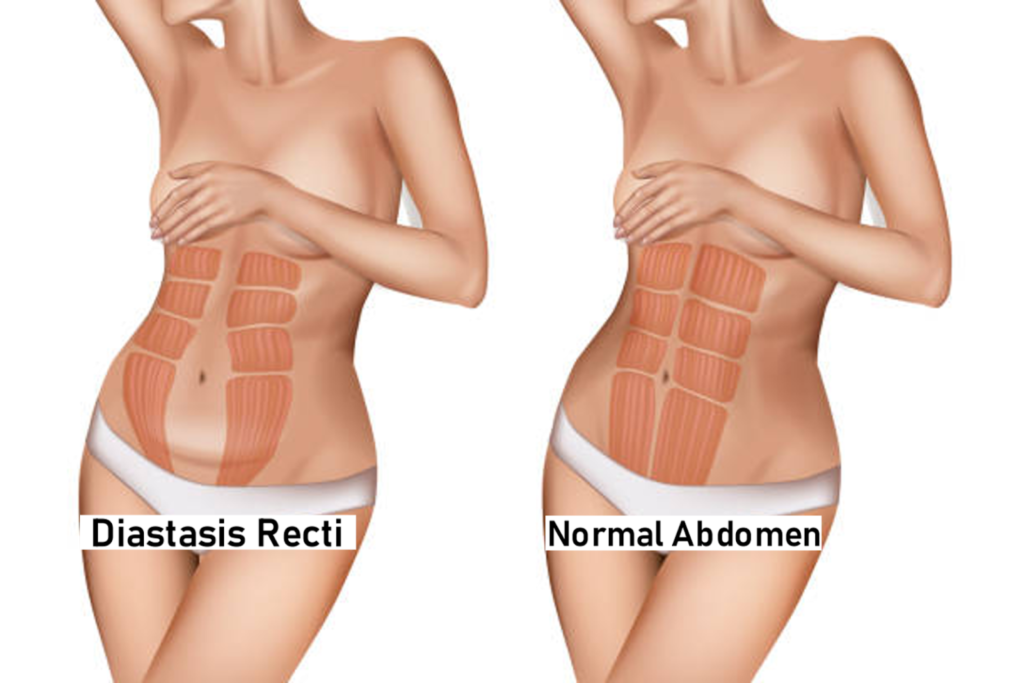
Diastasis recti is the separation of the rectus abdominis muscles, leading to a gap or a soft bulge under strain. It occurs in 100% of women postpartum, so testing for it should be done no earlier than 6–8 weeks after delivery.
How to Check for Diastasis
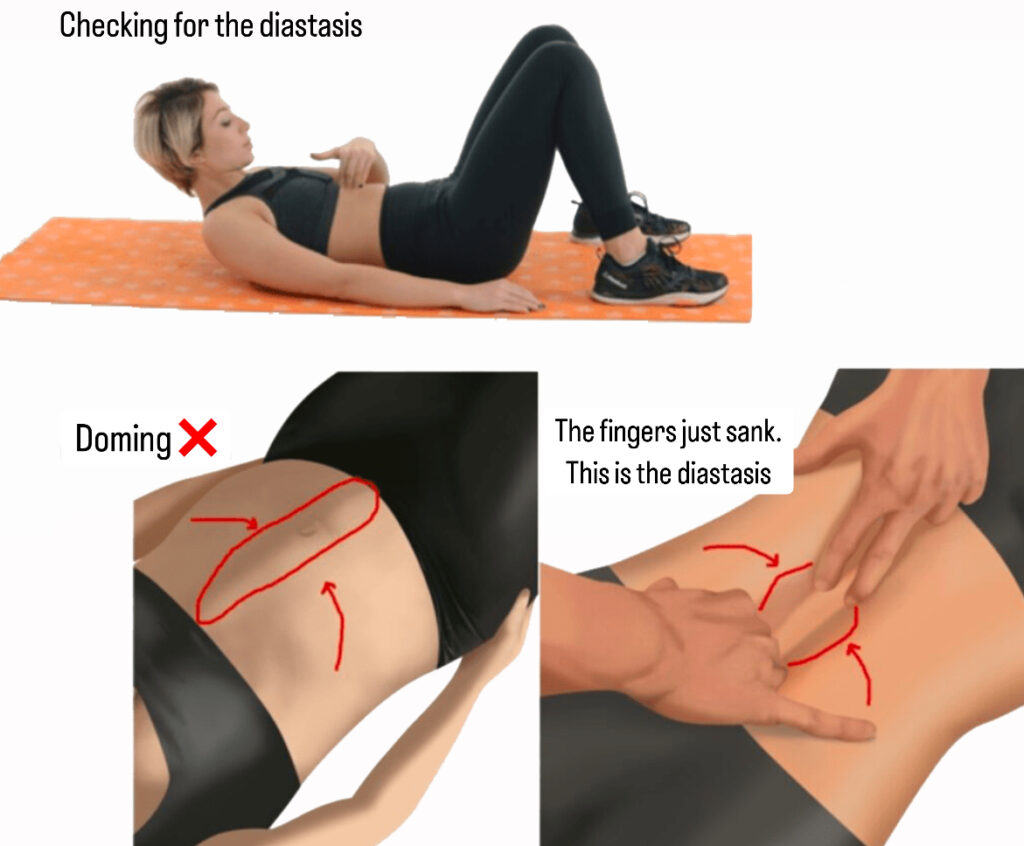
- Lie on your back with your knees bent and feet flat on the floor.
- Lift your head, while keeping your shoulders on the floor. This engages your abdominal muscles.
- Hold your head with one hand and start checking with another hand. Put three fingers in the area of the belly button along the linea alba of the abdomen.
- Feel for a gap between the muscles. Now measure the length of the diastasis: put three fingers near the navel, above the navel and below the navel, and check how long the diastasis is along the linea alba. I recommend writing it down.
- Then check how wide the diastasis is across and put one finger, two or more. If you can fit two or more fingers into the space, you might have diastasis recti. If it’s more than four fingers, it’s a reason to consult a surgeon, who can tell you if you have an umbilical hernia and need to have surgery.
- Next, check the depth by noting how far your fingers sink between the muscles. If the tissue bumps into something firm, you don’t have diastasis. If this tissue is loose, and the fingers just sank without feeling the bottom, you have diastasis.
If it’s only one finger, it’s the limit of the norm, basically nothing to worry about. If it’s bigger, there is still something to work on. First of all, make sure that during exercises and everyday life, when your abs engage, you avoid doming/coning of your abs.
Why It’s Important to Address Diastasis Recti
If left untreated, diastasis recti can lead to:
- Lower back pain
- Poor posture
- Pelvic floor dysfunction
- Hernias
Strengthening your deep abdominal muscles can help close the gap and improve core function.
Key Principle: Learning to control and engage your deep abdominal muscles is crucial. Initially, focus on conscious activation during exercises. Over time, this will become automatic, helping to reduce the diastasis.
Important: When performing any abdominal exercises, ensure you’re engaging the deep core muscles to prevent the midline from bulging or doming. If you can’t keep your belly firm during exercises (there is doming), reduce the range of motion and move more slowly, or choose less intense exercises.
In the first few weeks after childbirth, your body is especially vulnerable. Start exercising around 6–8 weeks postpartum, once the bleeding has stopped. Until your abdominal muscles get stronger, make it a habit to lie down and get up through your side.
How to Check for Diastasis
How to Avoid Doming
The Most Important Skill Postpartum: Core Training
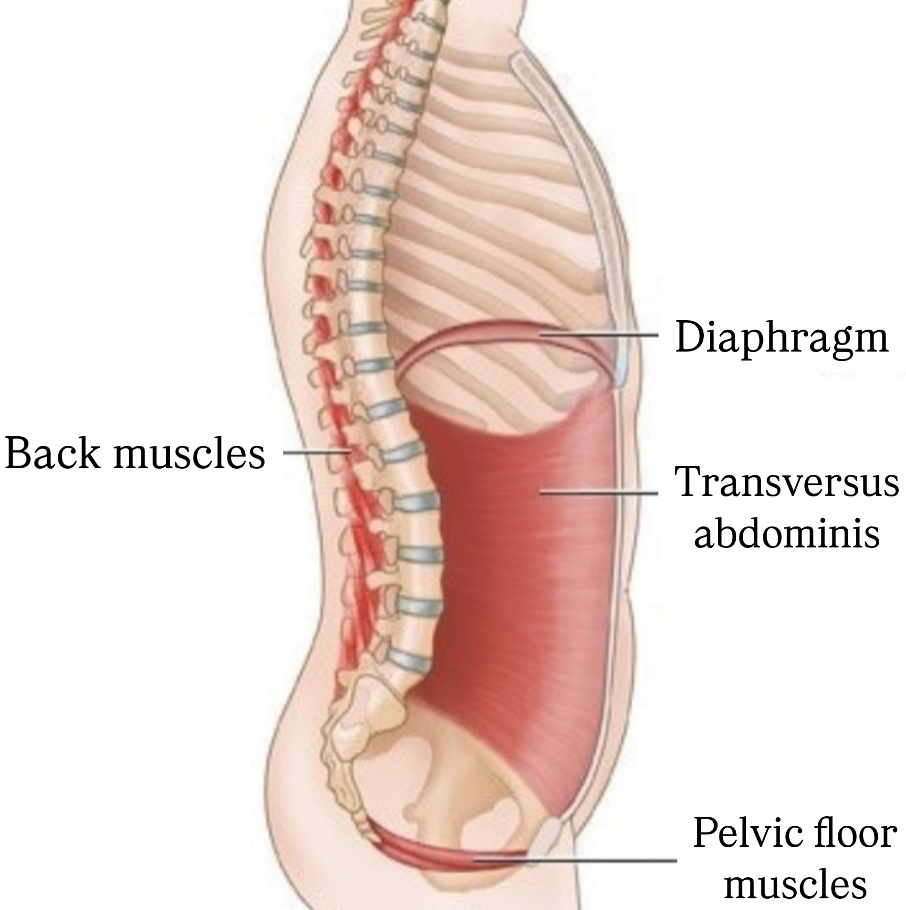
Teaching your deep core muscles and pelvic floor to work together. So what can you do to tighten your belly? Strengthen your core muscles!
The core is like a “box” inside your torso:
- The top is the diaphragm
- The bottom is the pelvic muscles
- The front is the abdominal muscles
- The back is the spine and deep back muscles
Only when your core muscles are strong will you achieve a firm, toned belly! This means your workout can be just 20 minutes a day, but it should include women’s exercises: ones that engage the diaphragm, back, pelvis, and deep abdominal muscles.
Do these two workouts one after the other (they complement each other perfectly). You can do them every day!
10-Minute Abs Workout
Diastasis recti safe exercises
10-Minute Back Workout
Diastasis recti safe exercises
Nutrition Tips: 3 Habits to Shrink Your Belly
If you don’t have excess weight, your diet is balanced, varied, and healthy, and you don’t experience bloating or digestive issues, but you still have a slightly protruding belly, core exercises may be enough.
If you do have excess weight, avoid strict diets and sudden restrictions on your favorite foods! Instead, focus on balanced meals throughout the day (with the right proportion of proteins, fats, carbs and fiber). When your body gets everything it needs, cravings for unhealthy foods naturally decrease, and surprisingly, you stop overeating!
Learn how to balance your diet on your own or take a course from a specialist if you struggle with self-discipline.
Three Eating Habits That Help Reduce Belly Fat
Avoid Snacking Between Meals
Allow your body to fully digest each meal before eating again (only water and unsweetened drinks are allowed). Wait 3–4 hours before your next meal! Otherwise, bloating, gas, and constipation may occur. If bloating is a regular issue, your body weakens the abdominal muscles to create space for digestion, making a flat belly impossible! Keep meals simple: just 2–3 ingredients per meal until you determine the cause. If you struggle with avoiding snacks, consider whether snacking is your main source of joy, and fill your life with engaging activities instead.
No Screens While Eating
Make meals a mindful experience: just you and your food. The more aware you are of what and how much you eat, the less likely you are to overeat.
Go to Bed With a “Light” Stomach
Finish dinner 3–4 hours before bed so your body can fully digest it, and you’ll wake up feeling light, energized, and ready for the day. 7:30 PM is an ideal time to finish dinner. Going to bed with a “heavy” stomach means morning fatigue, puffiness, and a bad mood.
Conclusion
If you found this mini-course helpful, please share it on your social media. If you have any questions, write to me at online@frolovatatiana.pro.

Meet Tatiana
My name is Tatiana Frolova. I’m 36, a postpartum recovery coach and a mom of 6. I completed two professional diplomas in Postpartum Recovery and Posture Correction.
Drawing on my six postpartum recoveries and professional training, I created workout programs that won’t take much time or energy and will gently help your body regain its shape and the ease of movement it once had.
Ready to Take Your Body Back?
Strong Within is the program for preparing the body for pregnancy and restoring it after childbirth.
- Full 10-week Strong Within program
- 3-month online access to the program
- 30-day money-back guarantee
The Greatest Thing You Can Do for Your Children Is to Take Care of Their Mom
Start with the free lessons today, one small habit at a time.
Questions? Write to us at online@frolovatatiana.pro